

A lot of homeowners have likely asked themselves why a cash offer for their property isn’t what they’d get in an open market situation. So if you’re one of them and you’re scratching your head after being presented with a cash offer, trust me, you’re not alone. Most people are shocked (and sometimes confused) when they first see a cash offer because it is usually well below their list price expectation. If I receive an amount that’s much lower than my asking price, I’m naturally going to wonder where that cash buyer gets their number. The reality is that cash buyers have a rather defined formula for how to arrive at a cash offer. It isn’t random; there isn’t a personal slant to it; once you understand the mathematics behind it, you’ll see that their cash offer actually makes sense! Let’s break down How Cash Buyers Calculate Offers on Your Home.
What Is a Cash Offer Based On?

Investors who buy properties for cash (also known as investors or companies that buy houses) are not affected by emotions when determining an asking price for a property. They base their pricing on an objective formula that revolves around ARV (After Repair Value).
ARV is how much value your house will have once all improvements have been made. They gather data from similar properties in your area to come up with an ARV for your house.
The Core Formula Cash Buyers Use
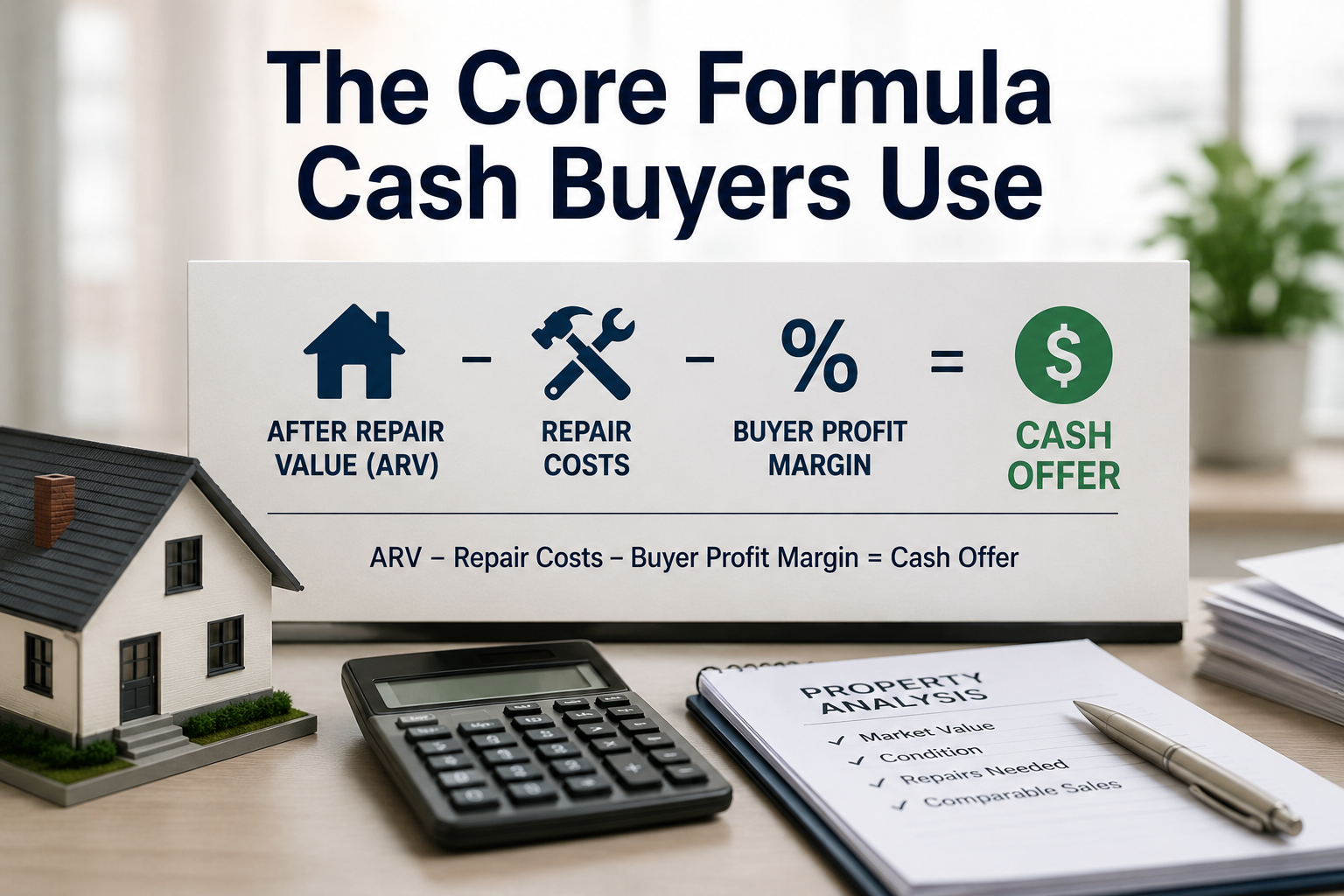
The basis for the majority of cash purchases is the following formula regarding the cash offer: Cash Offer = After Repair Value (ARV) X 70% – Estimated Repair Costs
As an example, your properties after repair value (ARV) is $250,000 and your estimated repairs are $30,000, then your cash offer would be determined as: ($250,000 x 0.70)-$30,000 = $145,000
This 70% rule represents industry-wide guidelines concerning profit margin, holding costs and risk to the investor.
What Costs Do Investors Factor In?
As a cash buyer evaluates the property, a variety of cost categories are built into the property evaluation.
- Repair & Renovation: The total amount spent to bring your home up to an acceptable condition will account for everything from major repairs such as a new roof all the way down to cosmetic repairs such as flooring, paint or a kitchen update. Even minor deferred repairs add up quickly.
- Holding Costs: Holding costs represent what the investor will have to spend while the property is being renovated (typically 3-6 months). During that time, the investor will have to pay property taxes, insurance, utility bills and interest on any loan if applicable.
- Selling Costs: After the investor has completed the renovation, they will then put the house up for sale. They will incur agent commissions (typically 5-6%), closing costs and staging costs after going through the sale process.
- Profit Margin: The investor has to take a real financial risk when investing in homes. A reasonable profit margin (typically 10-20% of the ARV) is built into every single offer they make to ensure that their deal remains viable.
Why the Offer Is Lower Than Market Value — And Why That’s Fair

Cash buyers don’t make low balls; they are paying you for everything that’s not on the open market such as:
- You do not have to do any repairs
- You will close within days vs months
- There are no agent commissions or fees
- You will not have financing contingencies that may fall through
- You won’t have home inspections ruining the deal at the last minute
Basically you are paying more for the convenience, speed, and certainty they give you—many sellers believe it is worth it!
Factors That Can Raise or Lower a Cash Offer
Not every offer follows the same number. Several factors shift the final figure:
| Factor | Effect on Offer |
| Location/demand | Higher ARV = higher offer |
| Condition of the home | More repairs = lower offer |
| Market conditions | Hot market = better offer |
| Timeline flexibility | More flexible = sometimes higher |
| Title issues or liens | Can reduce or delay the offer |
Conclusion
When you understand the cash buyers’ calculations, you’ll be much less anxious throughout the process. With a solid formula based on actual costs, actual risks, and actual market data, broken into parts and clearly defined, you can see why those numbers come to that conclusion.
If you’re interested in selling your house for cash, but you want a cash offer that has no pressure or mystery, then please reach out to AJ Buys Houses! You can count on us to help you with each step of the process and provide clarification about each part of the cash offer you receive. We will ensure that you fully understand the amount and reason for your cash offer.
Frequently Asked Questions
Why is the cash offer on my home so much lower than what I see homes selling for in my neighbourhood?
Good question – and trust me, most sellers will ask the same thing.
The homes you see near your home that are for sale have generally been totally upgraded, staged and sold by a realtor that had been marketing for 6 months or longer.
When a cash buyer purchases your property, they are buying it “as-is” without having to undergo the updating, staging and 6+ month marketing. The cash buyer then assumes the costs associated with making repairs, as well as the risks associated with those repairs. The difference in the cash buyer price and the price you are asking for your property is the amount of work, time, and money they will invest once they purchase the property from you.
Did the cash buyer just pick a random number, or is there actually a method to it?
There is no guessing involved here; there’s an actual process. Most cash buyers will take the after repair value (ARV) of a property (what they feel the home would be worth after repairs), multiply it by about 70%, and then deduct the estimated cost of repairs to come up with a price they are willing to pay. While it may look unemotional on paper to you, every number in this equation corresponds to a cost to them!
Can I negotiate, or is the offer take-it-or-leave-it?
It’s very possible for you to negotiate! An experienced cash buyer is not likely to walk away just because you resisted them. If you feel that the estimated cost of repairs is higher/below what you think it should be, or if you believe the original offer does not accurately reflect the benefits/features of your home, you should say so! Good, honest, and fair cash buyers appreciate this kind of communication and it builds their trust and helps to create a number that both parties can agree on.
What exactly are they spending money on after they buy my house?
To many people’s surprise. Other than the regular ‘obvious’ renovations (e.g. kitchen remodelling or roof repairs), an investor will also incur property taxes, insurance and utility bills every month during the renovation period. When they do finally sell, the investor has to pay agent commissions, closing costs and staging fees. The margin for profit on the total investment is usually far less than what it appears to be.